

 Exode team
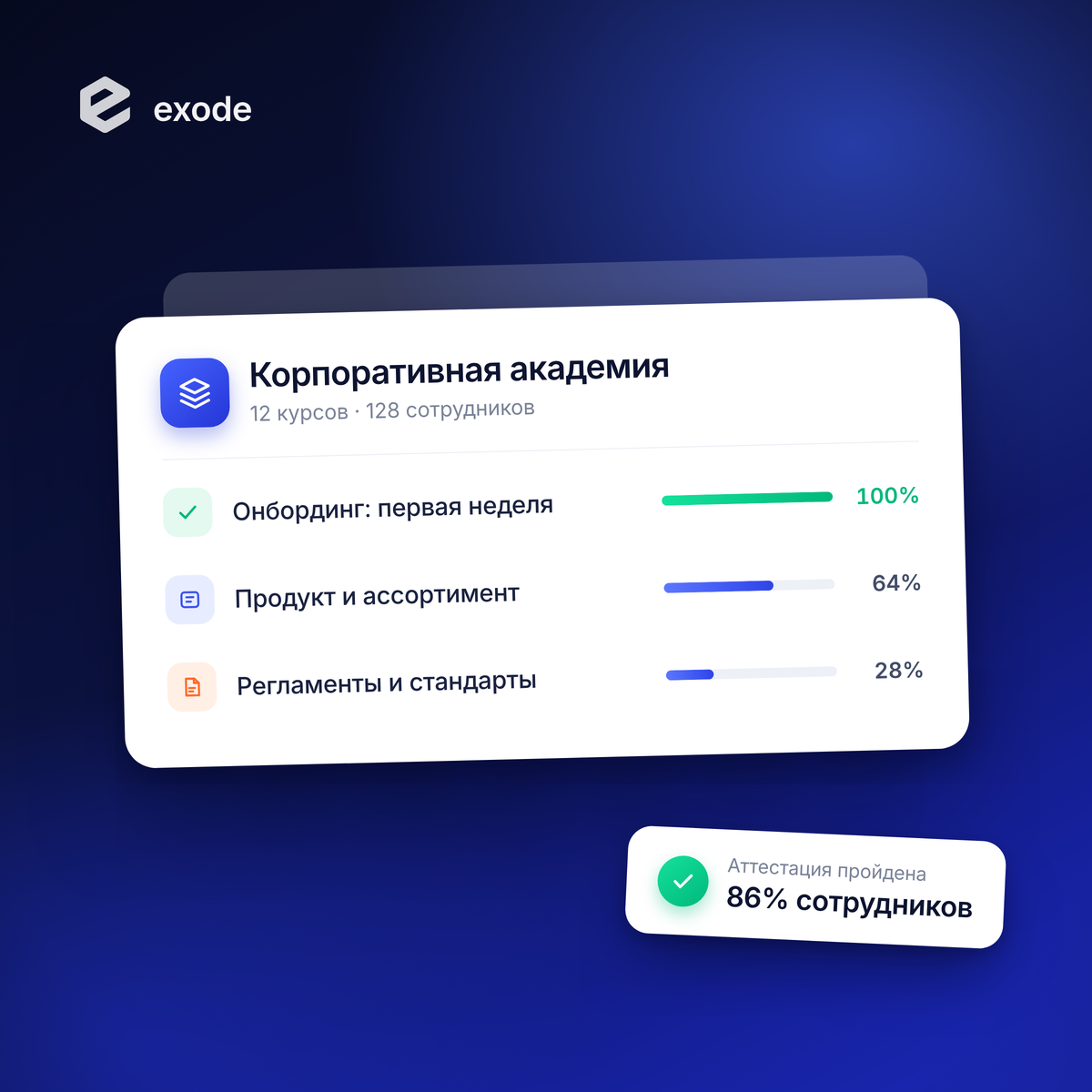
The company already has training. The manager explains things to new hires, there are webinar recordings somewhere, instructions in Telegram, slides on Google Drive, and a trainer is brought in twice a year.
There is training. There is no system.
The difference shows up when you ask three simple questions. Which employees have read the new policy? How many people actually know the product line? What does a new hire go through in week one — and is it the same for everyone?
If nobody can answer, training in your company rests on people rather than on a process. That is what an LMS and an internal academy solve — and they are not the same thing.
What an LMS is An LMS (Learning Management System) is a platform where a company stores training materials, assigns them to employees, tests knowledge and tracks each person's progress. Unlike a folder of files or a work chat, an LMS holds not just materials but data: who completed what, who passed the test, who never started. Companies use an LMS for onboarding new employees, product training, sales enablement, assessments and storing internal policies.
How an LMS differs from a folder of files
Slides on a drive and instructions in Telegram are storage. Storage answers "where is it" and leaves three other questions open: who studied it, who understood it, and what happens to the people who didn't.
An LMS differs from storage in three functions:
- Assignment. Material doesn't sit and wait — it reaches a specific employee with a deadline.
- Verification. A quiz or assessment shows the person absorbed the material rather than scrolling past it.
- Analytics. You can see who completed it, who's stuck and who never started, without chasing people for updates.
With five employees you can hold all this in your head. With thirty you can't.
An LMS is a tool. The academy is what you bought it for
This is where most companies go wrong.
You can buy an LMS in a day. You cannot buy an internal academy: it isn't software, it's a product inside the company, and it has four parts.
- A program. What you teach, to whom, in what order. One track for new hires, another for sales, another for managers.
- An owner. A specific person responsible for the materials existing and staying current.
- Content. Courses, policies, quizzes — someone creates them and then keeps them up to date.
- Metrics. A clear answer to what all of this is for and what the result looks like.
A platform without those four turns into the same Google Drive, only more expensive. Courses get uploaded once, nobody updates them, three months later it holds outdated policies, and employees go back to asking in chat.
The rule is simple: decide first what you're teaching and to whom. The platform is how you deliver that, not a substitute for deciding.
What an internal academy covers
It usually starts with one job and grows into the rest.
Onboarding. A new hire follows the same path regardless of who happened to meet them. The manager stops explaining the same things to every person.
Product training. When the lineup changes, the course is updated once instead of being re-explained to thirty people separately.
Sales enablement. Scripts, objection handling, case reviews. A new rep gets all of it at once instead of collecting fragments from colleagues.
Policies and knowledge base. Documents live in one searchable place, and knowledge checks can be attached to them.
Assessments. Regular confirmation that employees know what they're supposed to know. In some industries it's also a legal requirement.
Development and talent pipeline. Employees can see what they need to learn for the next role, and grow inside the company instead of leaving for growth.
Partner training. For franchises and dealer networks — a way to push standards outward without visiting every location.
When it's time
Companies rarely build this proactively. They build it once the signs pile up:
- HR or managers answer the same questions from every new hire;
- how fast a new hire becomes productive depends on who trained them;
- you can't quickly say who completed mandatory training;
- a strong employee leaves — and part of your knowledge leaves with them;
- policies are written, but nobody is confident anyone has read them;
- training happens once and is forgotten;
- you open a new location or build out a team, and all the training has to be repeated from scratch.
A rough size marker: this usually becomes noticeable at 5–10 hires a year. But the trigger isn't headcount, it's repetition. If the same training gets delivered more than twice, it's cheaper to record it once.
What an LMS should include: the minimum
If you're evaluating platforms, use this as a checklist:
- Course builder — video, text, documents, the order people move through them.
- Automatically checked quizzes — otherwise knowledge checks become manual work again.
- Assignment by role or department — so you aren't distributing courses by hand.
- Analytics — who completed, who's stuck, who never started.
- A searchable knowledge base, separate from courses: policies are needed during work, not during training.
- Certificates and assessments — especially where knowledge checks are mandatory in your industry.
- A mobile app — for people who don't work at a computer: retail, warehouse, delivery.
- Access rights — a manager sees their department, HR sees everyone.
- Easy content updates — if editing a course requires a developer, the material will go stale.
How to tell whether the academy is working
Without numbers, any internal system turns into a formality within six months. The minimum set:
- Time for a new hire to reach expected performance. The headline number; compare across roles and periods.
- Turnover in the first 3–6 months. Leaving in that window usually says more about hiring and onboarding than about the employee.
- Share of employees completing mandatory training on time.
- Volume of repeat questions to HR and managers. A question every new hire asks belongs in the knowledge base.
- Assessment results over time, not as a one-off.
How this works in Exode
On the platform the academy is assembled from ready-made pieces, with no development work:
- Courses — the program is split into modules and lessons and employees work through it step by step.
- Knowledge base — policies, instructions and documents in one searchable place.
- AI assistant over the knowledge base — employees ask in plain words and get an answer from your own documents instead of going to their manager.
- Quizzes and assessments — automatically checked, so the real level is visible.
- Analytics — who completed what, who's stuck, who hasn't started.
- Course assignment by role and department.
- Mobile app — for frontline staff.
- Your own brand and domain — the academy looks like part of the company, not an outside service.
The main effect is simple: knowledge stops depending on one specific person. When a strong employee leaves, the training program stays with the company.
Where to start
The most common mistake at the start is trying to document every process at once. That's usually how the project dies before reaching its first employee.
- Pick the one role you hire for most often.
- Write down the questions every new hire in that role asks. That list is the content of your first course.
- Build the course from what you already have — policies, slides, recordings of internal training.
- Add a quiz at the end so you can see the person understood it.
- Run it with one new hire and ask what was missing. Fill the gaps and keep using it.
The first version doesn't need to be perfect. It needs to be better than "go ask a colleague."
To see how it works, you can try our platform free for 7 days. Get in touch — https://t.me/exode_biz_support