

 Exode team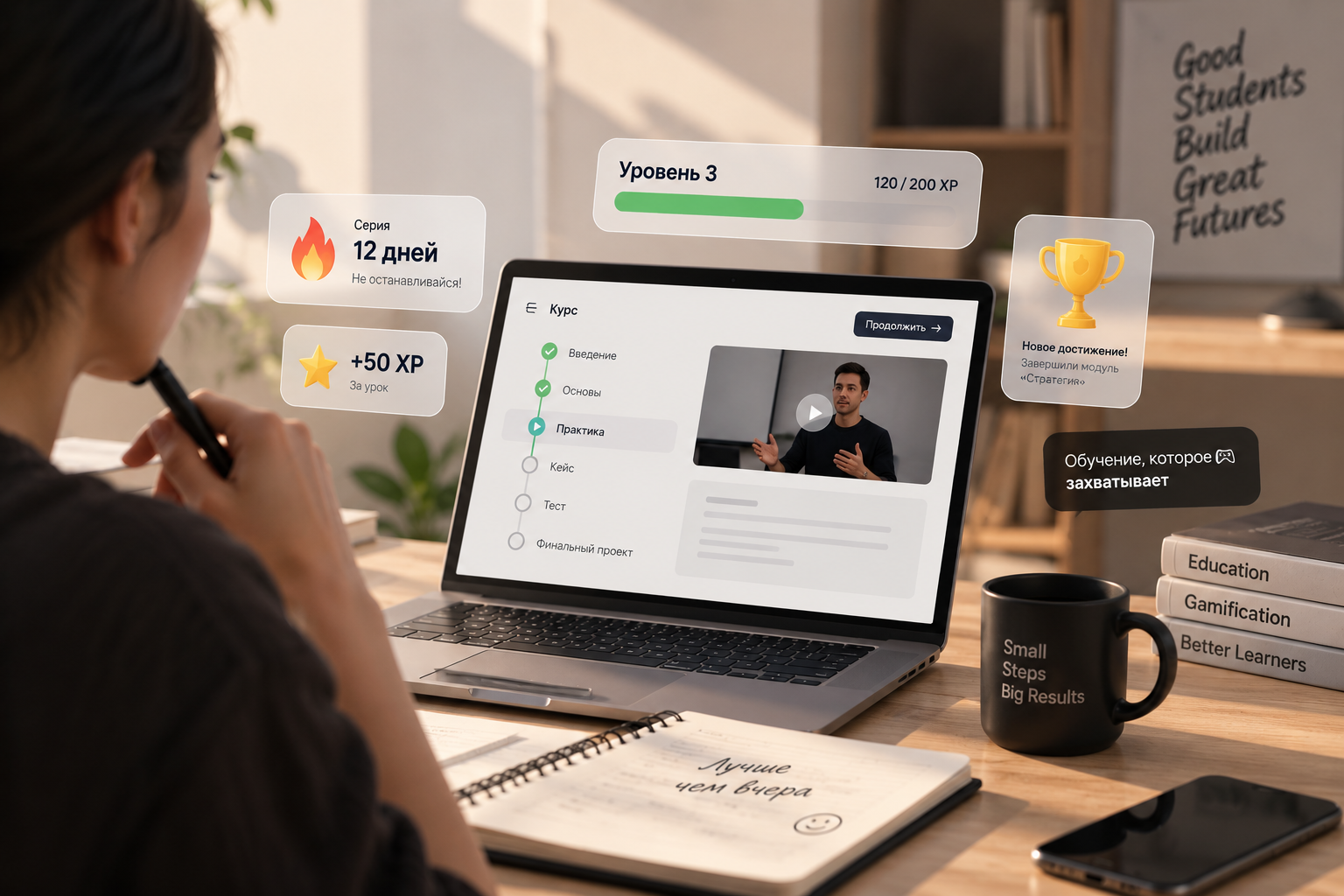
A familiar story: a school adds gamification, hands out badges for completed lessons, and a month later the completion rate is exactly where it was. The conclusion is usually wrong: "gamification doesn't work."
It does. Just not as decoration on top of a course nobody was finishing anyway.
What gamification actually is
It isn't "turning the course into a game." It's borrowing the mechanics that hold attention in games for years:
- you can see where you are and how much is left;
- feedback arrives immediately, not a week later;
- the next goal is always clear;
- you feel yourself getting better.
Points, levels and achievements are the form. Their job is to make invisible progress visible. If there's no progress, awarding points for it is pointless.
The gap gamification actually fills
Students quit at three predictable moments, and each has its own mechanic.
After the first lesson. They don't yet know how long this will take or whether they can handle it. A quick first win plus a visible progress bar — "1 of 12 completed" — does the work.
In the middle of the course. The hardest module, no help, and the starting enthusiasm is gone. Here you need intermediate goals: levels, cohort ranks, rewards for finishing a block rather than the whole course.
Before the final assignment. The fear of not being good enough. What helps is visible proximity to the goal — "3 lessons to your certificate" — and a clear reward at the end.
Gamification isn't about entertainment. It's about giving the student a reason to continue at the exact moment they're wavering.
Mechanics that actually work
1. Progress that's always visible. The most underrated mechanic and the cheapest one. Completion percentage, closed modules, a countdown to the certificate.
2. Points for things that affect the outcome. The key word is "affect." Points for submitted homework and passed quizzes — yes. Points for logging in — no: you'll get students who log in and do nothing, plus broken analytics.
3. Levels and ranks. These work over long distances, when a course runs for months. They create a sense of growth while the finish line is still far away.
4. Achievements for behaviour, not attendance. "Five assignments in a row," "first to answer in the cohort chat," "revised the work after feedback." These also signal to students which behaviour you consider right.
5. Rewards they can spend. This is where gamification connects to sales: points convert into a discount on the next course, access to a closed review session, an extra consultation. A student who spent a whole cohort collecting points is more likely to buy the next program.
Tip Start with progress and points for homework. Those two carry most of the effect. Levels, achievements and a rewards shop are worth building once the first two are working.
Where gamification breaks
Points that lead nowhere. If 500 points buy nothing at all, students stop noticing them within a couple of weeks.
A global leaderboard. It looks impressive, but in practice it motivates the top five and demotivates everyone else — the person in 84th place simply stops opening it. If you want competition, keep it inside a small cohort group, or compare a student against their own previous result.
Rewarding activity instead of results. The student farms points with clicks, the metrics go up, the learning doesn't. Test yourself with one question: if someone scores the maximum, have they definitely learned anything?
Gamification instead of content. If the course is boring and badly structured, badges won't save it. Program first, game layer second.
Overdoing it. When everything awards points, studying turns into farming, and external motivation starts crowding out interest in the subject itself. Three or four mechanics are usually enough.
So — trend or tool?
Both, depending on what you're implementing. Badges as decoration are a trend. A system where the student always sees progress, gets feedback and has a reason to come back tomorrow is a tool that moves completion directly.
And completion isn't a pedagogical question, it's a financial one. Students who finish leave reviews, become case studies, buy the next product and bring their friends. Students who drop out at lesson two do none of that.
What to measure
To know whether it worked, you need before-and-after numbers on at least one cohort:
- Share of students reaching the last lesson.
- Share submitting assignments.
- Return rate: how many open the course 7 and 30 days after the start.
- Conversion of graduates into the next product.
If completion doesn't move, the points are almost never the problem — usually it's the course content, or a game layer that isn't tied to real progress.
Where to start
Don't build the whole system. Take one live cohort and add three things: visible progress, points for submitted assignments, and one clear reward for finishing. Compare completion against the previous cohort.
If there's a difference, build out levels, achievements and point redemption. If there isn't, the problem isn't gamification — look at the program.
In Exode, gamification is configured inside the course itself: no separate services, no development work. You can see how it looks in practice in the feature video walkthrough